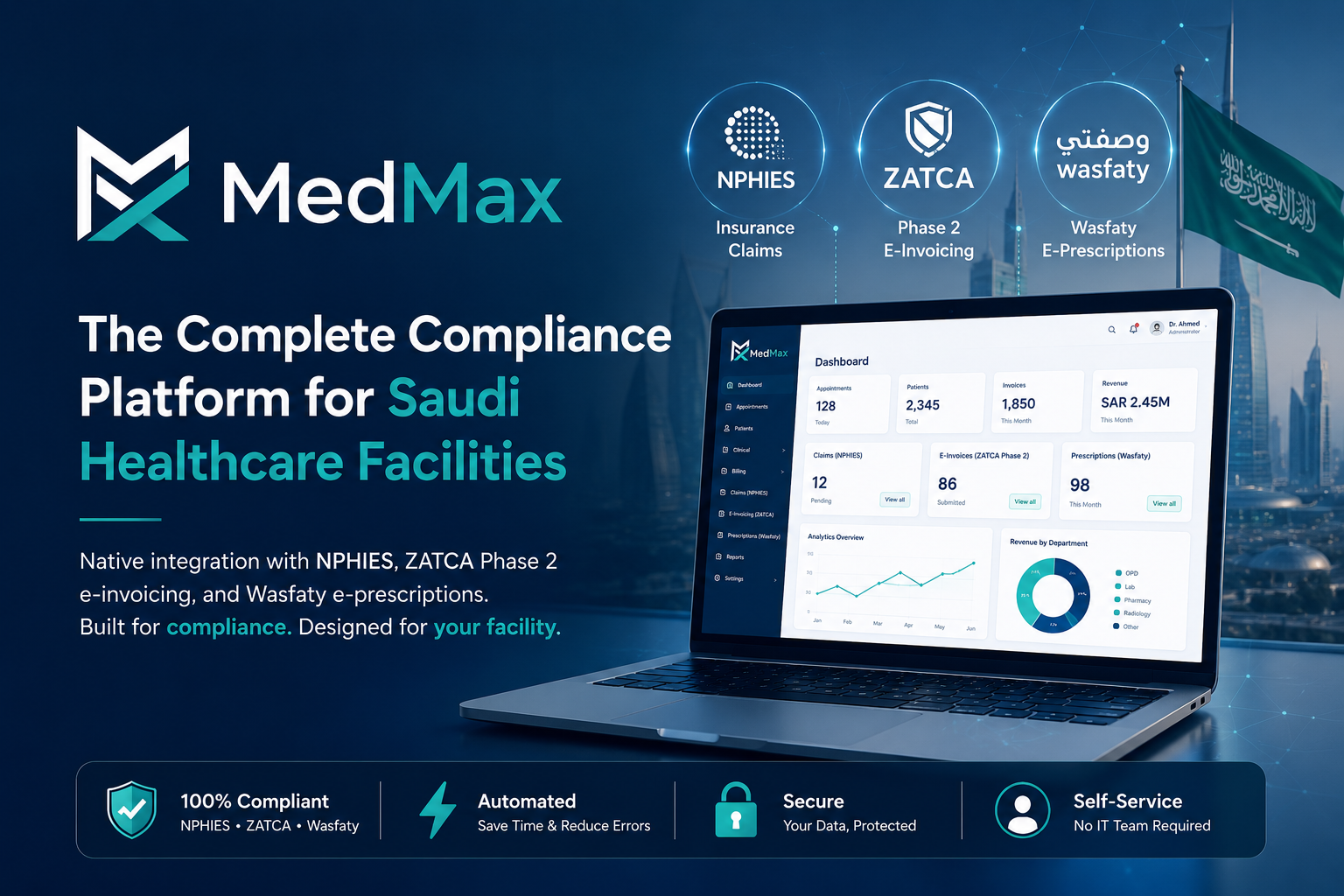
MedMax is a medical facility management system built for the Saudi market, with native integration for NPHIES (the national insurance platform), ZATCA Phase 2 e-invoicing, and Wasfaty e-prescriptions. It automates the technical complexity of regulatory compliance so facilities can stay compliant without needing a dedicated IT team.
The Compliance Challenge in Saudi Arabia
Saudi healthcare facilities operate under some of the region's strictest digital regulations. Insurance claims must flow through NPHIES, every invoice must meet ZATCA Phase 2 requirements, and prescriptions connect through Wasfaty. Each system carries its own technical demands — and handling them manually drains staff time and risks costly penalties. The real challenge is not understanding the rules, but implementing them technically. This is exactly where the right system makes the difference.
What Is MedMax?
MedMax is an integrated medical facility management system designed specifically for the Saudi market. It unifies appointments, electronic medical records, billing, and reporting in a single platform, with the local regulatory integrations a Saudi facility needs built in from day one — not added as an afterthought.
Native NPHIES Integration
NPHIES is Saudi Arabia's unified platform connecting healthcare providers with insurers. MedMax connects directly to it, allowing facilities to verify patient eligibility, submit claims, and exchange data in real time. Eligibility can be checked in seconds before the patient is seen — not discovered after the service is delivered — which protects revenue and speeds up the patient journey.
Built-In ZATCA Phase 2 E-Invoicing
ZATCA Phase 2 (the Integration Phase) requires invoices in XML format (UBL 2.1), a cryptographic stamp (CSID) issued by the authority, a TLV-encoded QR code, and direct integration with the Fatoora platform. With Wave 24 in June 2026 lowering the threshold to SAR 375,000 in annual revenue, the vast majority of clinics and facilities now fall under the mandatory scope. MedMax handles all of this automatically:
- Generates compliant XML invoices in the background.
- Applies the cryptographic stamp and QR code to every invoice.
- Automatically distinguishes between simplified invoices (for individual patients) and standard invoices (for insurers), routing each through the correct workflow.
- Reports simplified invoices to Fatoora within the required 24-hour window.
Wasfaty E-Prescription Connectivity
MedMax connects to Wasfaty, enabling physicians to issue electronic prescriptions directly within the system. This removes paper handling, reduces errors, and keeps the prescription workflow inside one unified platform.
Why Local Integration Matters
A globally powerful system that lacks local integration forces a Saudi facility into costly manual workarounds, no matter how advanced it is technically. MedMax is built around Saudi requirements, so compliance is part of the system itself — not a custom project added later. That is the core difference between a system designed for the Saudi market and one merely adapted to it.
Self-Service Operation
The biggest barrier for facilities is the fear that compliant systems require technical experts to run. MedMax is designed so the facility's own staff can operate it through a clear Arabic interface, with no dedicated IT team required — combining the strength of professional systems with everyday simplicity.
Frequently Asked Questions
Is MedMax integrated with NPHIES? Yes, MedMax connects directly to NPHIES, enabling real-time eligibility verification, claim submission, and data exchange with insurers.
Does MedMax meet ZATCA Phase 2 requirements? Yes, MedMax automatically generates compliant XML invoices, applies the cryptographic stamp and QR code, and reports to the Fatoora platform within the required timeframe.
Does MedMax support Wasfaty e-prescriptions? Yes, physicians can issue electronic prescriptions through Wasfaty directly within MedMax.
Does running MedMax require a technical team? No, MedMax is designed for self-service operation through a clear Arabic interface, so facility staff can manage it without dedicated IT support.
Who is MedMax suitable for? MedMax serves Saudi medical facilities seeking full compliance with NPHIES, ZATCA, and Wasfaty in one integrated, easy-to-operate platform.
Conclusion
For Saudi healthcare facilities, regulatory compliance is not optional — it carries real deadlines and real penalties. The challenge is the technical implementation. A system that automates NPHIES, ZATCA, and Wasfaty compliance end to end is the safest, simplest path to staying compliant. MedMax is built for exactly that.